

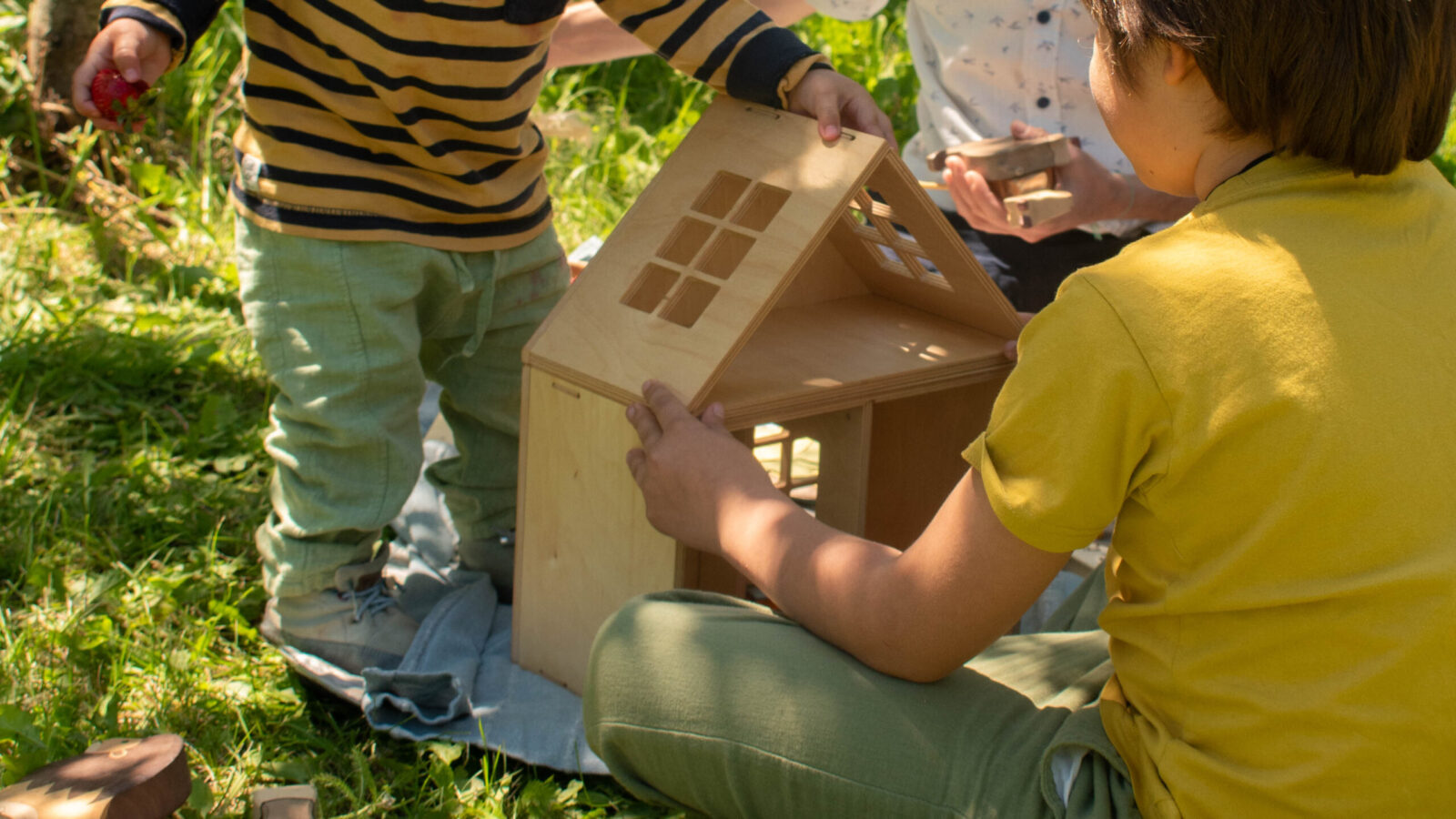
There’s something magical about watching a child lost in dollhouse play – the whispered conversations between tiny residents, the careful rearranging of furniture, the stories that unfold room by room. If you’re considering a dollhouse for your little one, you’re probably feeling a mix of excitement and overwhelm. I get it. With so many options out there, how do you choose something that will truly spark joy and imagination?
Let me walk you through this with you. After years of watching children play and listening to parents, I’ve learned what really matters – and I want to share that with you, whether you end up choosing one of my dollhouses or finding something else that’s perfect for your family.
A small note before we start: I want to mention that at the end, you’ll find a simple checklist I’ve put together that you can download, print, or save to your phone while you’re shopping. You can take it with you, tick off what matters to your family, and use it to compare options.
Short on time?
Keep reading for detailed guidance on each point
START WITH YOUR CHILD
Before you fall in love with any particular dollhouse, take a moment to think about your unique child.
How do they play? Some children love creating spaces – they love setting up elaborate scenes, arranging and rearranging, creating cosy worlds that stay put for days. Others are adventurers who want to carry their play wherever inspiration strikes, setting up on the kitchen floor one moment and under the dining table the next. Neither is better; they’re just different, and the right dollhouse honours how your child naturally engages with the world.
What stage are they at? A three-year-old’s needs look different from a seven-year-old’s. Younger children often do beautifully with something simple and open-ended – fewer rooms, sturdier construction, space for their imagination to fill in the details. Older children might crave more complexity, more rooms to organise, more architectural details to inspire their increasingly sophisticated stories.
Will siblings or friends be playing together? If you envision multiple children gathered around, you’ll want something substantial enough to support collaborative play without constant conflicts over space. There’s something beautiful about watching siblings create shared worlds together – but only if there’s room for everyone’s ideas.
IT’S NOT JUST A DOLLHOUSE
Let me pause here for a moment, because I know some of you might be thinking: “But my child isn’t interested in dolls.”
Here’s the beautiful truth: these aren’t just houses for dolls. They’re structures for imagination. They’re garages for vehicle collections. They’re barns for animal families. They’re fire stations, police headquarters, vet clinics, dragon lairs, space stations, and whatever else your child dreams up.
I’ve watched children line up their car collection in the rooms, creating elaborate parking garages with different levels. I’ve seen farm animals take up residence, with each room becoming a different part of the farm. Action figures, dinosaurs, Pokemon characters – they all need places to live and play out their adventures.
And here’s something equally magical: I’ve watched children recreate their own worlds. The classroom where something exciting or confusing happened. The restaurant they visited last weekend. The doctor’s surgery they’re trying to make sense of. These play structures become safe spaces to replay, process, and understand their experiences. A child might set up a “school” to work through friendship dynamics, or a “shop” to practise the grown-up interactions they’re observing and learning.
The word “dollhouse” is really just shorthand for “open-ended play structure with rooms and levels.” What your child does with it? That’s entirely up to them. Some children will create domestic scenes. Others will create workshops, laboratories, adventure headquarters, shops, schools, or things we adults would never imagine. Some will use it to make sense of their day, their feelings, their growing understanding of the world.
So if you’re shopping for a child who loves dolls, trucks, animals, action figures, or simply recreating the world around them – this guide is for you. The questions are the same: what kind of play structure will support your child’s unique imagination and needs?
THE PRACTICAL STUFF
Size and Space
I know you’re picturing where this dollhouse will live – because let’s be honest, it needs a home too. Measure that space before you shop. Consider not just the dolls’ house’s footprint, but the play space around it. Children need room to sit, to reach all sides, to spread out their play figures, vehicles, animals, and all the treasures that make the play come alive.
Think vertical as well as horizontal. Can your child comfortably reach the top floor? Will it feel overwhelming in your space, or just right?
Weight and Mobility
Here’s something many parents don’t consider until it’s too late: can you move it? Maybe today it lives in the playroom, but what about when you need to hoover, or when your child wants to bring their play closer to where you’re working? Some dollhouses are beautiful statement pieces that become permanent furniture. Others are light enough to relocate as life and play demand.
If you’re someone who values flexibility – in your space and in how play unfolds – this matters more than you might think.
Storage Reality
Let’s talk about the elephant in the room: what happens when the dollhouse phase ends, or when you need the space for something else? Some dollhouses disassemble easily and tuck away. Others… don’t. If storage is a concern (and when isn’t it?), look for designs that can break down without requiring an engineering degree to reassemble.
WHAT MAKES PLAY COME ALIVE
Open-Ended Design
The dollhouses that get played with year after year? They’re the ones that leave room for imagination. Look for designs that don’t dictate the story – that can be a house today, a castle tomorrow, a school next week, or whatever your child dreams up.
Avoid dollhouses that are too themed or too detailed in their decoration. Children don’t need a chandelier painted on the ceiling – they need space to imagine one, or to imagine that ceiling opening to the stars, or becoming the floor of a dragon’s cave. The magic isn’t in what’s there; it’s in what could be.
Flexibility for Change
Children’s play evolves, sometimes week to week. Can the dollhouse evolve with them? Look for designs where rooms can be reconfigured, where walls might move or reverse, where your child can participate in redesigning their play space. This isn’t just about the physical furniture – it’s about giving your child agency in their play world.
Inspiration Without Prescription
The best dollhouses strike a delicate balance: they offer enough structure to inspire storytelling, but not so much that they limit it. Interesting architectural details, multiple levels, varied room sizes – these things spark ideas. But the stories should come from your child, not from the manufacturer.
MATERIALS MATTER
The Wood vs. Plastic Question
I’m biased towards wood, I’ll admit it. But not just because I work with it – because I’ve seen how children interact with it differently. Wood has weight and warmth. It’s real in a way that connects children to the natural world. It invites touch. It ages gracefully, carrying the marks of play like medals of honour.
Plastic has its place – it’s lightweight, colourful, often less expensive. But ask yourself: what do you want your child to feel when they play? What materials fill your own home? What values do you want woven into their everyday experiences?
Wooden dollhouses often become keepsakes, passed down through generations. They’re investments in a different sense – not just financially, but emotionally and environmentally.
Natural vs. Painted Finishes
Natural wood grain tells your child: imagine what colour this is. A painted pink bedroom tells them: this is pink. Both can be beautiful, but they invite different kinds of play. Natural finishes tend to feel calmer, more open-ended. They work with any style of furniture, any colour scheme. They don’t clash when your child’s preferences change from purple-everything to blue-everything.
If you do choose painted, look for non-toxic, child-safe finishes. And consider whether the paint enhances play or limits it.
GROWING WITH YOUR CHILD
Some toys have a brief, bright season. The best dollhouses grow alongside your child for years.
Age Span
A well-chosen dollhouse can serve a child from toddlerhood through primary school and beyond – but only if it’s designed with that journey in mind. Look for:
Sturdy enough for young hands that are still learning gentle; Simple enough for beginning play; Complex enough to stay interesting as play grows more sophisticated; Versatile enough to support changing interests
The Modular Advantage
Here’s something worth considering: you don’t have to commit to everything at once. Modular dollhouses let you start small – maybe with just one or two rooms – and grow the house as your child’s play grows.
This is gentler on your budget, certainly. Instead of one large purchase, you’re making smaller investments over time. But it’s also responsive to your child. You get to see how they play, what they need more of, what captures their imagination. Maybe they need another bedroom for all their play figures. Maybe they need a tower for their adventure stories. Maybe they want to build wide instead of tall.
And practically speaking? Starting small means easier gift-giving for relatives. A new module for the dollhouse collection becomes a meaningful holiday or birthday present – something that builds on what they already love rather than adding more stuff to the toy pile.
BUDGET CONSIDERATIONS
Let’s be real: dollhouses range from very affordable to investment pieces that make you gulp. Here’s how I think about it:
Cost Per Play Hour
Rather than looking at the price tag alone, consider how much use it will get. A €200 dollhouse that’s played with almost daily for five years costs pennies per play session. A €50 one that gets abandoned after two months? That’s expensive.
Quality and Longevity
Cheaper doesn’t always mean economical. Flimsy construction means frustration, breakage, and eventual replacement. Solid construction – especially in wood – means years of play, possible hand-me-down to siblings or friends, maybe even grandchildren someday.
Start Small, Build Gradually
If a complete dollhouse feels overwhelming financially, remember that modular options let you begin with what you can afford and build over time. Your child won’t feel deprived starting with two rooms – they’ll feel excited about their house growing, about being part of that growth.
A FEW MORE THINGS TO CONSIDER
Personalisation and Self-Expression
Here’s something that can transform a dollhouse from a nice toy into a truly beloved treasure: the ability for your child to make it theirs.
Can your child easily change how the dollhouse looks? Are there options for adding wallpapers or changing wall designs? This might seem like a small detail, but wallpapers don’t just decorate – they inspire new stories. A brick pattern might suddenly transform a room into a bakery. Floral wallpaper becomes a garden shop. Stars and planets turn a bedroom into a spaceship. When your child can swap designs easily, they’re not just redecorating – they’re reimagining what’s possible.
When they can choose patterns, swap out designs on a whim, and see their own creative vision come to life, it becomes more than a structure – it becomes a canvas for their imagination and an invitation to endless possibilities.
Think about how easily changes can be made. Will your child be able to redecorate independently, or will they need adult help every time? The more agency they have in transforming their play space, the more invested they’ll be in the play itself.
Furniture Scale
Will the dollhouse work with play figures, vehicles, and accessories you already have? Standard doll sizes exist, but not all dollhouses accommodate them. If you’re inheriting Grandma’s doll collection or already have beloved tiny residents, make sure they’ll fit their new home.
Assembly Requirements
Some dollhouses arrive ready to play. Others require significant assembly – we’re talking hours and tools and maybe some choice words. Be honest about your time, patience, and skill level. There’s no shame in choosing something that lets you hand it to your child without a construction project first.
Safety
Check for:
Stability (will it tip if climbed on?); No small parts for younger children; Smooth edges and surfaces’ Non-toxic finishes; Appropriate weight for your child to interact with safely
TRUST YOUR INSTINCTS
I’ve given you a lot to think about, and I hope it helps rather than overwhelms. But here’s the truth: you know your child better than any guide, any review, any expert. You know what makes their eyes light up. You know what they’ll treasure.
When you find the right dollhouse, you’ll feel it. It will fit your space and your budget, yes, but it will also fit something deeper – your vision for your child’s play, your values, the kind of childhood you’re creating together.
Take your time with this decision. Imagine your child with different options. Picture where it will live, how they’ll play, what stories will unfold. The perfect dollhouse is out there – whether it’s handmade wood, carefully crafted modules you build over time, or something else entirely that speaks to your family’s unique needs.
Whatever you choose, you’re giving your child more than a toy. You’re giving them a world of their own to explore, a place where their imagination has free rein, where small hands can create and control and dream. That’s the real magic – not in the dollhouse itself, but in what your child will make of it.
Bobby